 Department of Agricultural Technology,
View count:
1049
Talent Cultivation Platform for Smart Agriculture
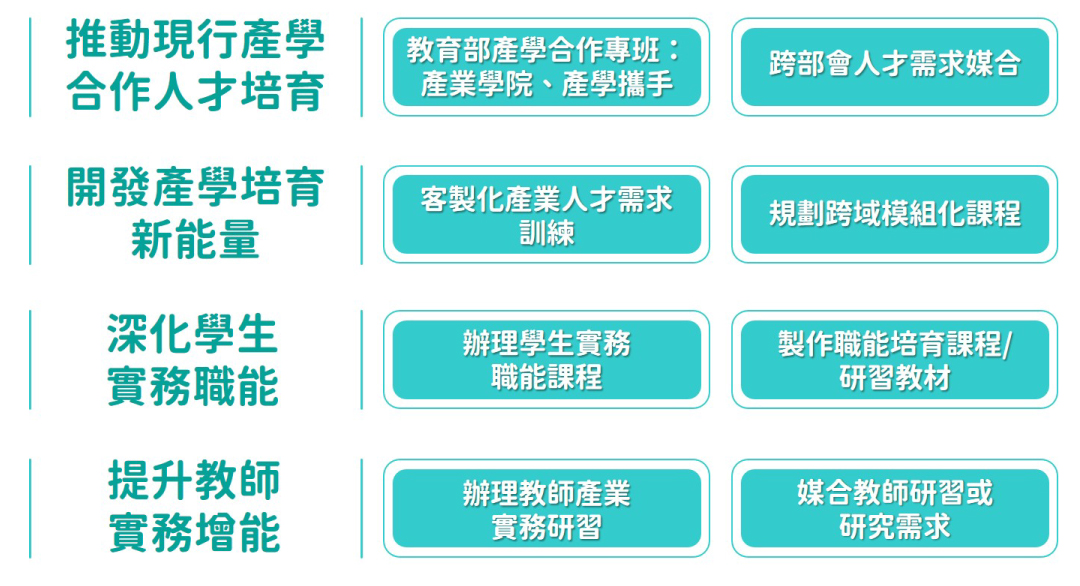
In order to understand the development of key national industries, the Ministry of Education has established the “Industry–Academia Collaboration Talent Development Platform” (referred to as the Talent Development Platform) and nine industrial sector working groups. This initiative is based on the distribution of industrial clusters and aligned with national policies for cultivating talent in key industries. To effectively grasp industrial development trends and demands and reduce the gap between academia and industry, the platform focuses on four major tasks: “promoting existing industry–academia cooperative talent cultivation,” “developing new capacities for industry–academia talent training,” “strengthening students’ practical professional competencies,” and “enhancing teachers’ practical professional capabilities.” Through this platform, technical and vocational universities and colleges across Taiwan, technical senior high schools (vocational high schools), discipline-based centers, and industry enterprises are connected to facilitate cooperative talent development.
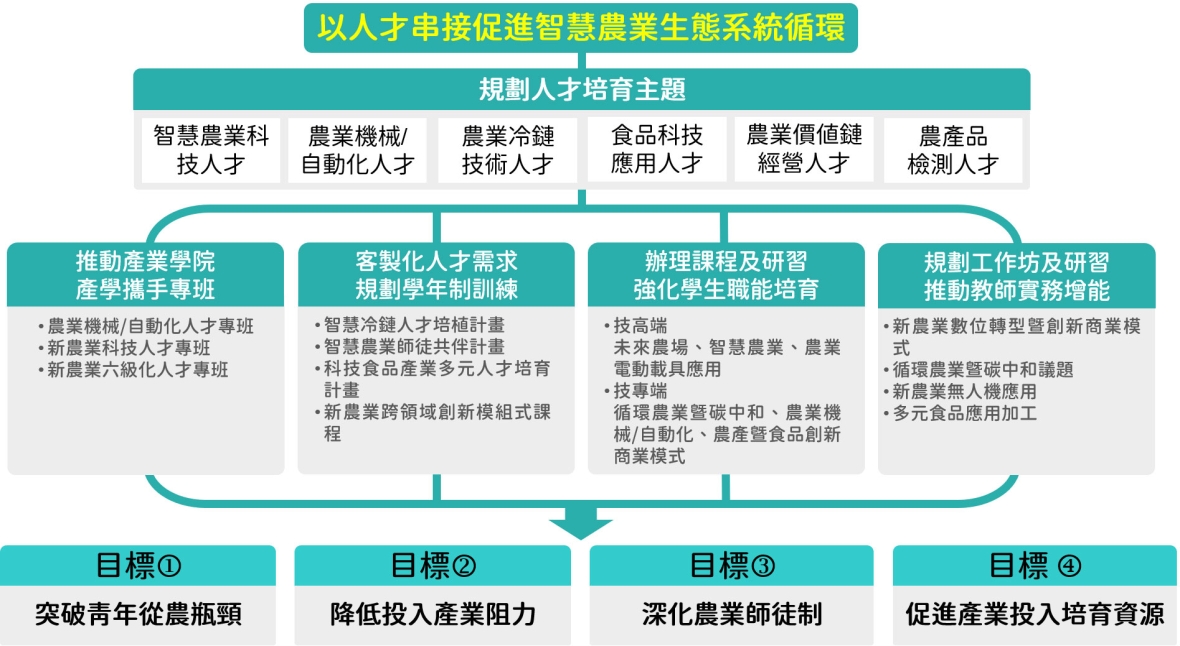
 This executive office actively collects information on industry talent demands and conducts in-depth assessments of agricultural industries and talent cultivation in agriculture-related departments of technical and vocational schools. It also organizes regional industry–academia collaboration forums and conducts visits with industry experts. The analysis identifies several challenges in agricultural talent cultivation, including: “insufficient understanding of the new agricultural industry among students and parents,” “the dignity of agricultural professions not meeting societal expectations,” “a lack of competency-based education courses and pre-employment experience opportunities,” “an urgent need for interdisciplinary talent,” and “the cultivation of sixth-level industrial thinking.” With the development of industry trends, the demand for agricultural human resources today extends beyond primary farming personnel. To meet the diverse talent needs across the entire agricultural supply chain, talent development programs must be implemented alongside the training capacities of technical and vocational schools. These efforts include expanding opportunities for industry–academia collaboration, promoting interdisciplinary modular courses or academic programs, establishing industry academy special classes, and organizing professional competency training programs for students and teachers. Through these initiatives, the perceptions of teachers, students, and parents regarding the industry can be transformed, while promoting the forward-looking development of the new agricultural industry and increasing opportunities for talents to enter the agricultural sector.